

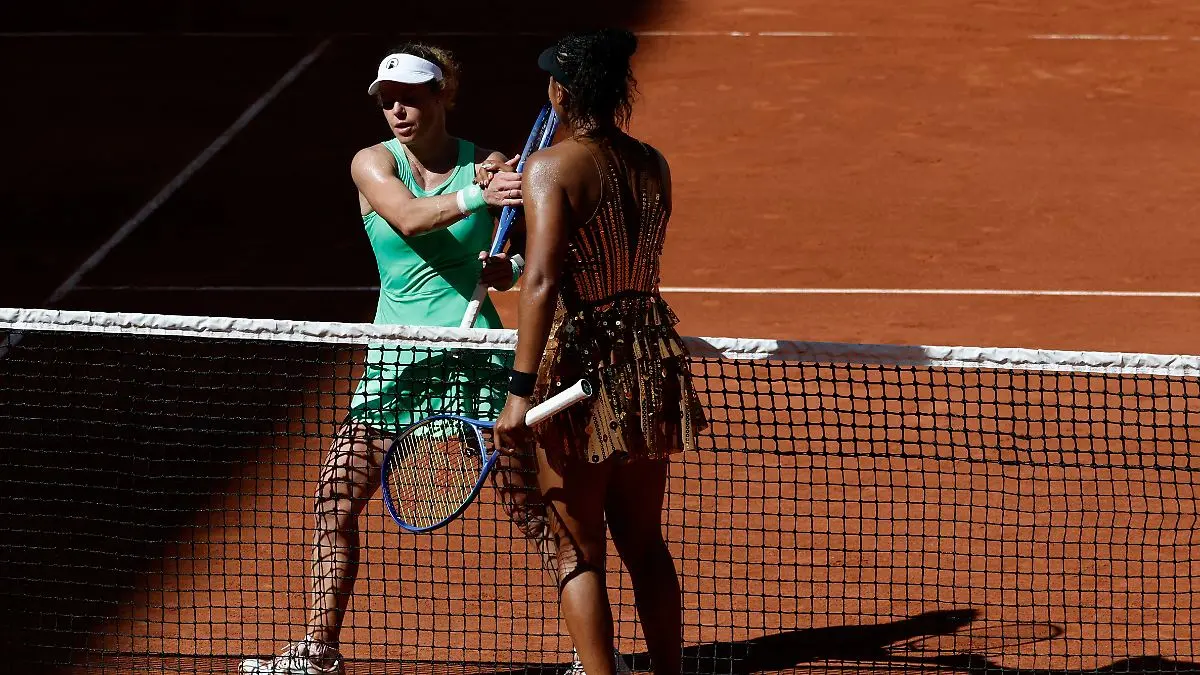
Osaka's Glitter Dress and Time Tactics: Siegemund Fumes Over Unequal Treatment
The 2026 French Open has already sparked controversy, not just because of Naomi Osaka's eye-catching glitter outfit, but due to allegations of preferential treatment from the umpire. German tennis player Laura Siegemund, after her first-round defeat, did not hold back in criticizing what she perceives as a double standard in enforcing time violation rules.
The Match and the Outburst
Siegemund lost 3-6, 6-7 (3-7) on Tuesday to the four-time Grand Slam champion. While the match itself might have been competitive, the post-match interview focused on something else entirely. Siegemund, visibly frustrated, told Eurosport: "The glitter dress is relatively irrelevant to me. What bothers me is the unequal treatment. At every tournament, they watch every second until you unpack your water bottle. But she can take one and a half minutes to change her outfit, and I have a problem with that."
Osaka had entered the court wearing a floor-length black glitter dress, which she then removed to reveal a bronze-colored glitter outfit for the actual match. This theatrical entrance, reminiscent of her white wide-brim hat and veil at the Australian Open earlier this year, has become a trademark of the Japanese star. But for Siegemund, it was not a fashion show: "I come here to play tennis, not to put on a fashion show. If others want to do that, it's fine with me. But such appearances should also be watched every second. That's the only thing regarding the rules that I find not okay."
Siegemund explicitly pointed to the umpire's inaction: "It shows once again that bigger names are treated differently than if I took that long or wore such an outfit and needed a little break here and a little break there. Then the umpire would issue a time violation. With her, he says nothing. That's the only thing that interests me. Whether someone comes in with a train or not, I don't care."
This incident adds to a long history of time violation controversies in tennis, particularly involving star players. The rules state that between points, players have 25 seconds (or 20 seconds after the serve motion starts), but enforcement has often been inconsistent. High-profile players like Serena Williams, Rafael Nadal, and Novak Djokovic have occasionally been accused of taking extra time without immediate penalties, while lesser-known players often face stricter enforcement.
Background on Osaka and Siegemund
Naomi Osaka, 28, is a former world No. 1 and a cultural icon beyond tennis. She has won four Grand Slam titles (two Australian Opens, two US Opens) and has been a vocal advocate for mental health and social justice. Her return to tennis after giving birth to her daughter in 2023 has been closely followed. Osaka has also become known for her unique fashion sense, often collaborating with designers to create memorable on-court looks. However, her slow playing style and tendency to take extra time between points have been criticized before.
Laura Siegemund, 38, is a German player known primarily for her doubles success (winning the 2020 US Open women's doubles title) and her fighting spirit. She has reached a career-high singles ranking of No. 29 in 2016 and has often played in the shadow of more famous German stars like Angelique Kerber. Siegemund has never been shy about speaking her mind, and this incident is not the first time she has called out perceived injustices on the court.
The Evolution of Time Violations in Tennis
The issue of time violations has become increasingly contentious in modern tennis. The introduction of shot clocks at many tournaments was meant to enforce consistency, but umpires still have discretion. In recent years, the debate has intensified, with some players arguing that the rules are applied unevenly based on a player's ranking or star power. Siegemund's comments echo those of other lower-ranked players who feel that the system favors the elite.
At the French Open specifically, the surface and the best-of-five sets (for men) often lead to longer matches, making time management crucial. However, for women's matches (best-of-three sets), the time rules are the same. The incident with Osaka could reignite calls for stricter and more uniform enforcement of time regulations.
Osaka has not responded directly to Siegemund's comments, but her focus remains on advancing in the tournament. She has spoken in the past about her love for expressing herself through fashion, saying it helps her feel confident and focused on the court. Yet, the line between personal expression and gamesmanship is thin, and many will now be watching to see if the umpires will crack down on her in future matches.
The broader implication for the sport is a question of fairness: Should the rules be applied equally to all players regardless of their box-office appeal? Or does the sport need to accommodate the personalities that draw fans to the game? Siegemund’s standpoint is clear: tennis is a game of rules, and those rules should be blind to fame.
Analysis of Umpire Discretion
Part of the problem is the subjective nature of time violations. The rules allow umpires to issue a warning on the first offense, then a point penalty, and then a game penalty for repeated violations. However, umpires often hesitate to penalize top players, especially in high-profile matches, as they risk backlash from both the player and the crowd. This creates a two-tier system where stars get more leeway.
In this case, Osaka changed her outfit between points or before the match? Siegemund's complaint seems to refer to the pre-match outfit change, which is typically not regulated by time rules. But she also mentions "one and a half minutes" during the match, perhaps referring to Osaka taking time between points to adjust her outfit or dry off. The exact timing is unclear, but the perception of favoritism is real for Siegemund.
This incident also highlights the pressure on umpires in the era of social media and instant replay. Every controversial call is dissected online. Meanwhile, players like Siegemund, who are not household names, may feel they have less influence to challenge decisions. She used the interview to voice what many lower-ranked players think privately.
As the French Open progresses, all eyes will be on Osaka to see if she continues her fashion statements and whether the umpires maintain a stricter watch. For now, the conversation has shifted from the sport itself to the rules that govern it—and the perceived inequality within them. Tennis fans and analysts will debate whether the sport needs a uniform enforcement policy or if a certain degree of flexibility for star power is acceptable entertainment value.
Ultimately, this is not just about a glitter dress or a time delay. It is about the integrity of competition. Siegemund's frustration is shared by many who feel that the scales are tipped in favor of the rich and famous. Whether that leads to any changes in how the French Open or the sport as a whole handles such incidents remains to be seen. For now, the German has spoken, and her words carry the weight of a growing sentiment in tennis: that the game must be fair for everyone, from the first round to the final.
Source: ntv.de News