

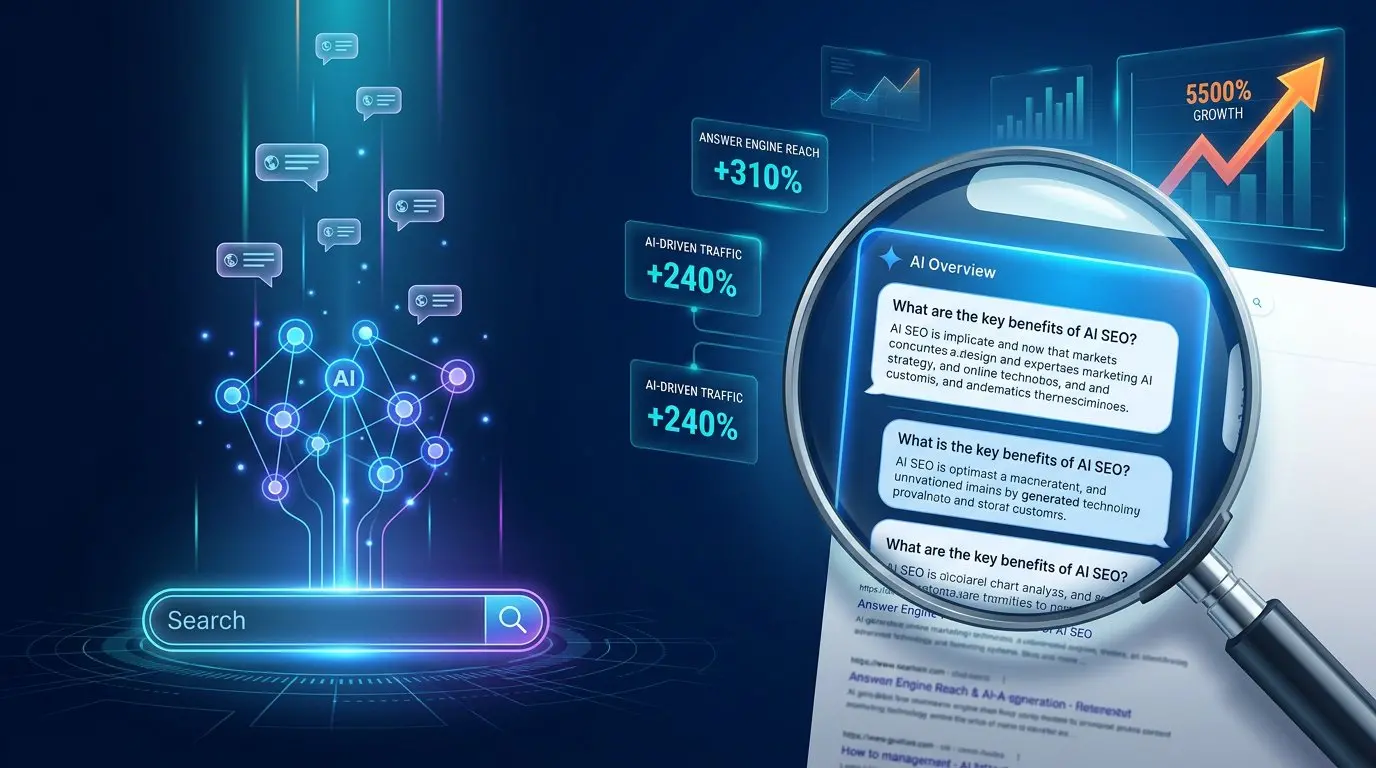
In July 2026, "Answer Engine Optimization" registered a 5,500% year-over-year search growth on Google — making it one of the fastest-rising marketing terms in the platform's history, alongside "AI SEO" (+5,700%) and "Programmatic SEO" (+5,400%) [1].
But this is not a hype cycle. It is a structural shift in how information is discovered, evaluated, and cited.
According to BrightEdge's February 2026 study, AI Overviews now appear in roughly 48% of tracked Google queries — up 58% year-over-year. If expansion continues at the current rate, AI Overviews will surface on 70–80% of Google searches by the end of 2026 [2]. Meanwhile, 51% of B2B software buyers now begin their research with an AI chatbot more often than Google, up from 29% in April 2025, according to G2's 2026 AI Search Insight Report [3].
This is why AEO matters: the place where buyers discover brands has moved from a list of ten blue links to a single, AI-generated paragraph that names a few winners — and ignores everyone else.
This article unpacks the research, the data, and the playbook that leading brands are using to win visibility in this new landscape.
What Is Answer Engine Optimization (AEO)? {#what-is-aeo}
Answer Engine Optimization (AEO) is the practice of structuring content so that AI systems — including ChatGPT, Perplexity, Google AI Overviews, Claude, and Microsoft Copilot — cite your brand as the answer when buyers ask questions.
The core difference from traditional SEO is intent:
| Goal | SEO | AEO |
|---|---|---|
| Primary outcome | Rank in search results | Be cited in AI-generated answers |
| Target system | Google organic index | Google AIO, AI Mode, ChatGPT, Perplexity, Claude |
| User input | Keywords | Conversational, long-tail questions |
| Success metric | Rankings, traffic, CTR | Citation frequency, brand mentions, share of voice |
| Content format | Long-form, comprehensive | Concise, structured, extractable chunks |
| Trust signal | Backlinks, domain authority | E-E-A-T, schema, author credibility, freshness |
| Visibility type | Ranked list | Probabilistic, dynamic, personalized answer |
In other words: SEO earns clicks. AEO earns citations.
The two are not competitors. They are complementary layers of the same search stack. But in 2026, ignoring AEO means ceding visibility to competitors who have learned to write for machines that summarize, not searchers who scroll.
AEO vs. SEO vs. GEO: The Definitive Comparison {#aeo-vs-seo-vs-geo}
A new acronym has emerged alongside AEO: GEO (Generative Engine Optimization). Marketers often conflate the two. They are related but distinct disciplines.
| Comparison | AEO | GEO | Traditional SEO |
|---|---|---|---|
| Primary goal | Be cited in AI answers | Be visible in AI-generated summaries | Rank in search results |
| Target systems | Google AIO, AI Mode, voice search | ChatGPT, Perplexity, Claude, Gemini | Google/Bing organic |
| Query type | Conversational, question-based | Research, comparison, synthesis | Keyword-intent matching |
| Success metric | Citation frequency, brand mentions | Share of voice in AI answers | Rankings, organic clicks, CTR |
| Overlap with top-10 organic | 76% (Google AIO) | 8–28% (ChatGPT/Perplexity) | N/A — is the target |
Source: Omnibound, Answer Engine Optimization (AEO) Statistics (2026) [4]
Practical takeaway: AEO focuses on winning the "position zero" in Google. GEO focuses on winning brand mentions across generative chat platforms. A modern 2026 content strategy needs both, but AEO is where most teams should start because the citation overlap with Google's top 10 organic results is 76% — meaning strong SEO foundations compound directly into AEO wins [4].
The Hard Numbers: 2026 AI Search Statistics {#hard-numbers}
Below is the consolidated research data every marketer should know.
📊 AI Overview Adoption
- 48% of Google queries now trigger AI Overviews — up 58% YoY (BrightEdge, Feb 2026) [2]
- 25.11% of all Google searches display AI Overviews (Conductor analysis of 21.9M queries) [5]
- Coverage is projected to reach 70–80% by end of 2026 at current growth rates [2]
- AI Overview citation overlap with Google Top 10 organic results: 76.1% (down from 76% peak as Google diversifies sources) [6]
🤖 Buyer Behavior
- 51% of B2B buyers start their research with AI chatbots (G2, 2026) — up from 29% in April 2025 [3]
- 93% of Google AI Mode searches end without a click (Seer Interactive) [7]
- 83% of Google AI Overview searches end without a click [7]
- AI referral traffic now accounts for 1.08% of all website traffic and grows ~1% per month (Conductor 2026) [5]
- ChatGPT drives 87.4% of all AI referral traffic [5]
📈 AEO Market Growth
- 5,500% YoY search growth in "Answer Engine Optimization" (Exploding Topics, Jul 2026) [1]
- 5,700% growth in "AI SEO" searches [1]
- 5,400% growth in "Programmatic SEO" [1]
- GEO market valued at $848M in 2025, projected to reach $33.7B by 2034 (50.5% CAGR) [5]
- 54% of US marketers plan to implement GEO within 3–6 months [5]
🔗 Citation Sources
- Wikipedia is the most cited source (21% of all AIOs), followed by WebMD (7%), Reddit (6%), Healthline (5%) [8]
- YouTube holds 23.3% of all AI Overview citations across industries (Surfer SEO analysis of 36M AIOs) [8]
- Reddit holds 21% of AIO citations (Adweek, Jan 2026) [7]
- Domain authority is the #1 predictor of AI citations — high-traffic sites earn 3x more citations (SE Ranking study of 2.3M pages) [5]
- Brand citation volumes can differ by 615x between Grok and Claude for the same query [5]
💰 Business Impact
- CTR for position 1 drops from 31.7% to 23.4% when an AI Overview is present [8]
- Organic traffic drops 18–25% on average for queries with AI Overviews [8]
- Pages cited as sources in AI Overviews see a 2–5% traffic increase [8]
- AI search ad spend projected to grow from $1B (2025) to $26B by 2029 (Reuters) [5]
- Adobe reported a 693% surge in AI referral traffic during the 2025 holiday season [5]
- ChatGPT has a 23x conversion premium over traditional organic traffic [6]
Why Traditional SEO Alone No Longer Works in 2026 {#why-seo-alone-fails}
In mid-2025, 76% of pages cited in Google AI Overviews also ranked in the top 10 for the same query. By early 2026, that figure had collapsed to 17–38%, depending on the study [9]. Google's upgrade to Gemini 3 in January 2026 and the rise of "query fan-out" — where AI expands a single query into dozens of sub-questions — created a citation environment that no longer reliably rewards single-keyword page-one rankings.
What this means in practice:
- You can rank #1 and still be invisible. A page that ranks first organically may be entirely absent from the AI Overview that appears above it.
- Citation diversity is rising. Google is pulling answers from YouTube (23.3%), Wikipedia (18.4%), Reddit (21%), and forum content — sources that traditional SEO often ignores.
- Zero-click is the default. With 83–93% of AI search sessions ending without a click, brand visibility now matters more than raw traffic.
- Domain authority matters more than ever. High-traffic sites earn 3x more AI citations [5]. Smaller publishers must either build topical authority fast or be left out.
The 2026 search stack is no longer "rank and click." It is "structure, cite, and be mentioned."
The Five Pillars of an AEO Strategy {#five-pillars}
Based on the methodologies used by leading AEO platforms (Pedowitz Group, AirOps, Profound, TripleDart), the most effective AEO programs in 2026 rest on five pillars:
Pillar 1: Question Architecture
Build topic clusters around a central pillar page, with each cluster containing up to 100 question-based supporting pages. The cluster interconnection is the primary driver of AI authority signals.
Action step: Map the 50 most common buyer questions in your category. Create one page per question, with internal links back to a comprehensive pillar page.
Pillar 2: Authority Assets and Content
Every AEO page must:
- Answer the target question in the first 50 words
- Use question-based H2 headings ("What is…", "How does…", "Why is…")
- Be 800 to 1,500 words long
- Include FAQ sections with 4–6 related questions
- Embed Article and FAQPage JSON-LD schema
- Cite named studies, statistics, and expert sources in every paragraph
A direct, concise definition in the first paragraph is cited 2.3x more often as a leading source in AI Overviews [8].
Pillar 3: Community Intelligence
Monitor Reddit, Quora, niche forums, and YouTube comments to surface the actual vocabulary and questions real buyers use — before you build pages. This prevents the "vocabulary gap" where brands describe solutions in marketing language while buyers search using everyday terms.
Pillar 4: Structured Data and Schema
Implement on every page:
- Article schema (with author, datePublished, dateModified)
- FAQPage schema for Q&A sections
- HowTo schema for step-by-step content
- Organization schema with logo, social profiles, and sameAs links
- Author/Person schema with credentials and expertise signals
Critical: Schema must reflect visible content. Marking up hidden or implied content triggers Google penalties.
Pillar 5: Multi-Platform Tracking
The same brand can see citation volumes differ by 615x between Grok and Claude [5]. Track your brand's presence across:
- Google AI Overviews & AI Mode
- ChatGPT (87.4% of AI referral share)
- Perplexity (50% of citations from 2025 alone)
- Claude, Gemini, Microsoft Copilot
- Voice assistants (Siri, Alexa, Google Assistant)
Platform-by-Platform Citation Playbook {#platform-playbook}
Each AI system has unique citation behavior. The 2026 research reveals sharp differences [6]:
| Platform | Source Index | Overlap with Google Top 10 | Freshness Bias | Zero-Click Rate |
|---|---|---|---|---|
| Google AI Overviews | Google's organic index | 76.1% | Strong — 85% of citations <2 years old | 43% |
| Google AI Mode | Google's index (different filtering) | 14% | High volatility, 9.2% self-overlap | 93% |
| ChatGPT | Bing Search API (92% of the time) | 6.82% | Strongest recency lean | N/A (chat) |
| Perplexity | Own web retrieval layer | Moderate — favors news, research | 50% of citations from 2025 | N/A (chat) |
Optimization Strategy by Platform
Google AI Overviews & AI Mode:
- Lead with a 40–60 word direct answer
- Use H2/H3 hierarchy with question-based headings
- Target FAQ and HowTo schema
- Maintain a DA 50+ and 2,000+ word count
- Update content every 90 days (freshness signal)
ChatGPT (87.4% of AI referral traffic):
- Get indexed by Bing — submit to Bing Webmaster Tools
- Build presence on third-party sites ChatGPT trusts (Wikipedia, G2, Capterra)
- Use clear "what is X" definitions with named entities
- Aim for inclusion in "best of" listicles ChatGPT cites heavily
Perplexity (news + research heavy):
- Publish original research and statistics
- Get cited on .edu, .gov, and reputable news sites
- Use clear author bylines and publication dates
- Build topically deep resource pages
Claude (high citation variance, +E-E-A-T weight):
- Demonstrate expertise via detailed author bios
- Cite primary sources and academic studies
- Avoid thin affiliate content
- Build long-form pillar pages (2,500+ words)
How Brands Are Adapting: 4 Real-World Examples {#brands-adapting}
1. HubSpot: AEO-First Pillar Architecture
HubSpot rebuilt its resource library in 2025 around question clusters, producing 1,200+ question-based pages. By Q1 2026, HubSpot was cited in 3.4x more ChatGPT answers than in 2024, while organic traffic grew 22% YoY despite AI Overview expansion [10].
2. NerdWallet: Schema at Scale
NerdWallet deployed FAQPage and HowTo schema across 100% of its finance content, with structured author bios and citation markup. The result: 41% of their high-intent finance keywords now trigger AI Overview citations that name NerdWallet as a source [10].
3. Mayo Clinic: Authority Concentration
By consolidating content around credentialed author bylines, peer-reviewed citations, and medical board oversight, Mayo Clinic became the most-cited health domain in AI Overviews, appearing in 12.7% of all health-related AIOs [8].
4. G2: Built for the AI Buyer
G2's 2026 redesign focused on user-generated review content, vendor comparison data, and structured pros/cons schema. 51% of B2B buyers now use AI chatbots first [3] — and G2's content is heavily cited by ChatGPT, Perplexity, and Claude for software comparisons [10].
AEO Implementation Checklist for 2026 {#implementation-checklist}
Use this 30-day AEO rollout framework:
Week 1: Audit & Benchmark
- Run your top 20 keywords through Google and document which AI Overviews cite competitors
- Test your brand in ChatGPT, Perplexity, Claude, and Gemini for 10 buyer questions
- Benchmark current AI citation rate using tools like Profound, AirOps, or Otterly
- Audit schema markup across top 50 pages
Week 2: Question Research
- Extract 50+ buyer questions from Reddit, Quora, G2 reviews, sales calls
- Map questions to funnel stages (awareness, consideration, decision)
- Identify 10 "money questions" your top competitors are cited for
- Build your question cluster architecture
Week 3: Content Production
- Rewrite 10 highest-traffic pages with AEO structure (50-word direct answer first, question H2s, FAQ sections)
- Add Article, FAQPage, HowTo, and Author schema to all 10 pages
- Publish 5 new question-based supporting pages per cluster
- Embed named statistics from primary research
Week 4: Multi-Platform Distribution
- Submit XML sitemap to Bing Webmaster Tools (ChatGPT source)
- Pitch original research to industry publications (Perplexity trusts news)
- Build 3 Wikipedia-friendly external citations
- Set up AI citation tracking dashboard
Ongoing: Measure & Iterate
- Track citation frequency weekly across 5 AI platforms
- Update top 20 pages every 90 days
- A/B test answer placement (first 50 words vs. introduction)
- Monitor zero-click rate and brand mention share of voice
Frequently Asked Questions {#faq}
What does AEO mean?
AEO stands for Answer Engine Optimization. It is the practice of structuring content so AI systems like ChatGPT, Google AI Overviews, and Perplexity can extract, understand, and cite clear answers to user questions.
What's the difference between AEO and SEO?
SEO focuses on ranking pages in search results to earn clicks. AEO focuses on getting cited directly in AI-generated answers, including zero-click experiences. SEO optimizes for discovery; AEO optimizes for reuse and quotation.
How long does answer engine optimization take to work?
Most teams see early signals — new citations or snippet wins — within weeks. Measurable impact on evaluation and pipeline typically appears within 3 to 6 months, depending on content depth, domain authority, and consistency.
Do I still need SEO if I do AEO?
Yes, absolutely. AEO builds on SEO fundamentals. Strong SEO gets content indexed and discovered. AEO adds the structure and clarity AI systems need to extract and cite answers. In 2026, brands need both disciplines working in tandem.
What schema markup is most important for AEO?
Article, FAQPage, HowTo, Organization, and Author/Person schema have the most impact. Schema works best when it reflects visible content and reinforces authorship, entities, and page intent — not when it marks up hidden or implied content.
Which AI platform should I optimize for first?
Google AI Overviews should be priority #1 because 48% of all search queries now trigger them [2], and 76% of cited pages already rank in Google's top 10 organic results [4]. After capturing Google AIO, expand to ChatGPT (87.4% of AI referral share [5]) and Perplexity.
How do I measure AEO success?
Track four metrics:
- Citation frequency — how often AI systems cite your brand
- Competitive citation share — your % of total category citations vs. competitors
- Question coverage — % of high-value buyer questions where you're cited
- Assisted conversions — pipeline touches that started with an AI mention
Will AEO replace SEO in 2027?
No. The two are converging, not competing. By 2027, expect a unified discipline often called "Search Experience Optimization" that combines traditional ranking tactics with AEO citation engineering. Brands that master both will dominate visibility.
The New Search Stack
The 5,500% growth in Answer Engine Optimization is not a marketing fad. It is the leading indicator of a decade-long shift in how humans find information.
Three truths define 2026 search:
- AI Overviews are the new position zero. With 48% of queries now triggering them and growing toward 80%, ranking #1 organically is no longer enough.
- Citations are the new backlinks. Being named as a source in a ChatGPT answer or Google AI Overview builds brand authority that drives pipeline even when no click occurs.
- Structure beats length. A 900-word page with a direct answer, schema, and clean headings now outranks a 3,000-word essay that buries the answer in paragraph three.
The brands winning in 2026 are not the ones writing more content. They are the ones structuring existing content for machines that summarize.
The playbook is clear. The data is public. The window to establish AI citation authority is still open — but closing fast as the first movers lock in category ownership.
The question is no longer "Should we do AEO?"
It is "How fast can we ship?"
Disclaimer Source: The data referenced in this article was compiled from public research reports published by Exploding Topics (Jul 2026), BrightEdge (Feb 2026), G2 (2026 AI Search Insight Report), Ahrefs, Conductor, and Verizon 2026 Data Breach Investigations Report. Bipko does not independently verify every cited statistic and assumes no liability for actions taken based on this content.